Markorax
DRIFT COLLECTION
DRIFT COLLECTION
Couldn't load pickup availability
Self-paced learning overview
- 📥 Digital file available after purchase
- ♾️ Long-term availability
- 🔒 Secure checkout
- 🗓️ Content updated in 2026
1. Problem Statement
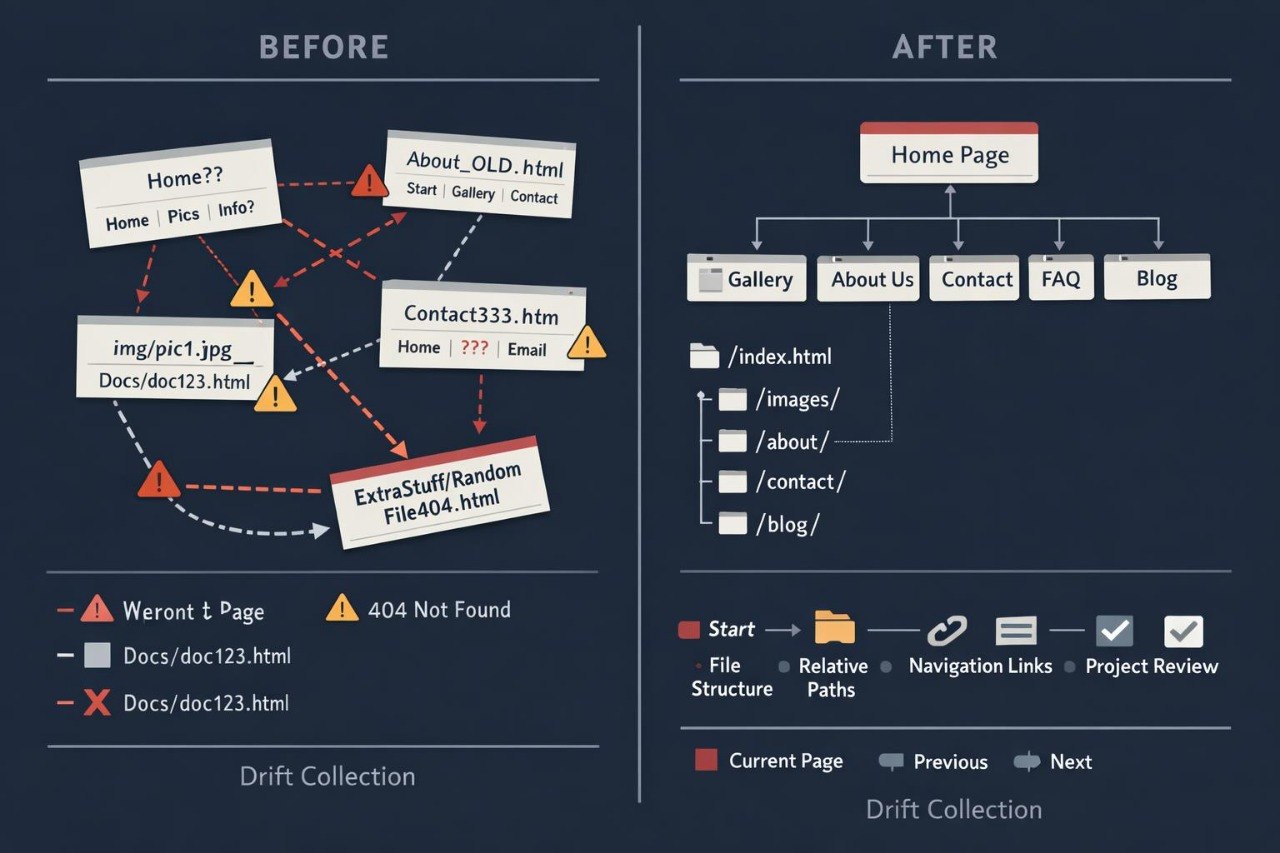
Struggling to maintain order when one HTML document develops into a site containing several connected pages? You are not alone: as a project expands, file names, relative paths, and repeated navigation blocks can become difficult to manage. A single incorrect link may lead to a missing page or an unintended section. When each document uses a different heading structure and menu order, the project may feel like a collection of unrelated materials. Without an initial plan, adding pages, reviewing routes, and maintaining consistent content organization becomes more complicated.
2. Solution
This course will teach you how to plan a multi-page HTML project before creating its individual documents. You will examine file naming, relative paths, primary navigation, internal links, and connections between thematic sections. The materials explain which parts should remain consistent across every page and which should reflect the subject of an individual document. Practical assignments guide you through reviewing routes, identifying broken links, and organizing nested folders. The final assignment is a small multi-page learning site with shared structure and consistent navigation.
3. What’s Inside
Module 1: Planning a Multi-Page Structure
You will create a project map, define the purpose of each page, and identify the relationships between its main sections.
Module 2: File and Folder Organization
This module explains readable file names, material placement, nested folders, and consistent project organization.
Module 3: Relative Paths
You will create links between files located on the same level, inside nested folders, and within parent directories.
Module 4: Shared Navigation
You will build a navigation block that appears across several pages while maintaining the same link order.
Module 5: Current Page Context
This module explains how the position and role of the current page can be communicated within the wider navigation structure.
Module 6: Internal Page Links
You will create links to document sections, page contents, and return links that lead back to the beginning.
Module 7: Connected Content Paths
You will arrange transitions between previous, current, and following materials without adding unnecessary repeated references.
Module 8: Consistent Page Templates
This module covers a shared foundation for headers, primary content, supporting navigation, and document footers.
Module 9: Link Review and Correction
You will review routes, correct inaccurate addresses, identify missing files, and examine inconsistent naming.
Module 10: Final Multi-Page Project
You will build a project containing at least five connected pages, a shared menu, internal links, and an ordered heading hierarchy.
4. Who Is This For?
✅ Suitable if you:
- already create individual HTML pages;
- want to connect several documents within one structure;
- work with relative paths and internal links;
- want to organize file and folder names;
- plan to create consistent navigation.
❌ Not suitable if you:
- have not yet studied foundational HTML elements;
- need materials about server-side routing;
- plan to create only one short page;
- do not intend to review files, links, and folder structure.
5. What You’ll Learn
- Create a map for a multi-page project.
- Define the purpose of each HTML document.
- Organize files and nested folders.
- Write relative paths between different folder levels.
- Build a shared menu for several pages.
- Add internal links to document sections.
- Connect previous and following materials.
- Review all routes before completing a project.
- Identify and correct broken links.
- Build a site containing at least five connected HTML pages.
6. Refund Policy
A refund request may be submitted within 30 calendar days of the course purchase date. Each request is reviewed according to the terms published on the Markorax website, including the amount of material already completed and other stated conditions.
7. Certificate
After completing all modules and the final multi-page project, the learner receives a Markorax certificate. The document records the course title and the main subjects covered.
1. How are the courses organized?
1. How are the courses organized?
Each course contains ordered modules, written explanations, HTML markup examples, practical exercises, and final assignments. Learners can study at their own pace and return to earlier topics whenever additional review is needed.
2. Is previous web development experience required?
2. Is previous web development experience required?
Previous experience is not required for the introductory plans. Later collections are intended for learners who already understand basic HTML tags and want to work with larger page structures.
3. How do the plans differ?
3. How do the plans differ?
The plans follow a gradual progression in material volume, module count, and assignment complexity. Introductory options cover foundational topics, while later collections examine semantic structure, forms, tables, multi-page projects, and more detailed markup organization.
4. Is a certificate included?
4. Is a certificate included?
Yes. After completing the required modules and final assignments, the learner receives a Markorax certificate. It records the completed course and the main subjects covered in the program.
Share