Markorax
LATTICE SUITE
LATTICE SUITE
Couldn't load pickup availability
Self-paced learning overview
- 📥 Digital file available after purchase
- ♾️ Long-term availability
- 🔒 Secure checkout
- 🗓️ Content updated in 2026
1. Problem Statement
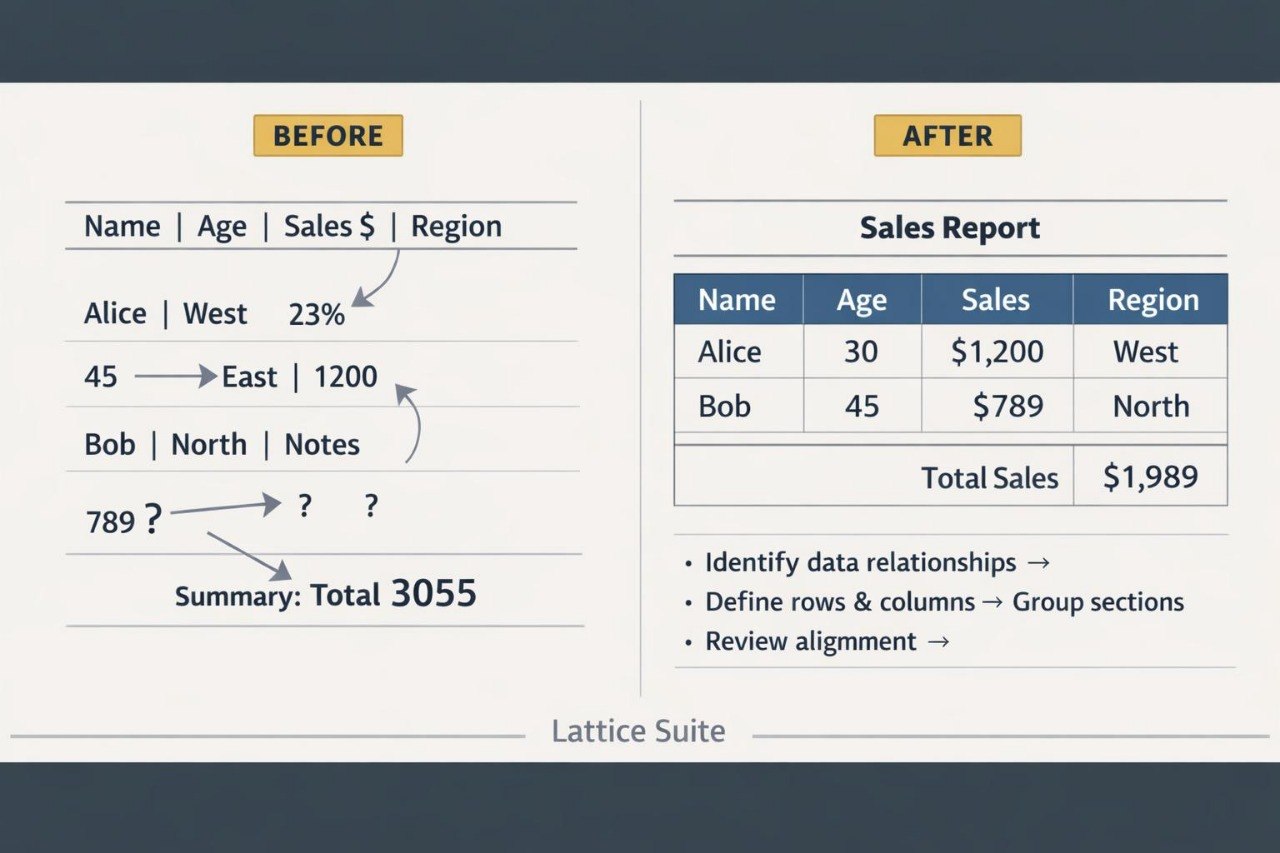
Struggling to create an HTML table containing several categories, values, and related explanations? You are not alone: tables are often built without a defined understanding of how rows, columns, and headings relate to one another. As a result, data may be arranged inconsistently, while individual cells lose their connection to the correct category. Large merged areas can also make the markup harder to review when they are added without a structural reason. As the table grows, even a small issue in element order can affect the entire information block.
2. Solution
This course will teach you how to create HTML tables around a defined data model. You will examine the purpose of rows, cells, headings, captions, and thematic groups within a table. The materials explain how to determine whether information belongs in a separate column or a separate row. Practical assignments guide you through reviewing data order, correcting unsuitable cell combinations, and adding context to detailed information sets. The final project combines several data categories within one structured table containing logical sections.
3. What’s Inside
Module 1: Understanding Tabular Data
You will identify which types of information belong in a table and which are better presented as a list or written section.
Module 2: Rows, Cells, and Headings
This module covers table, tr, td, and th, including the correct nesting order for each element.
Module 3: Captions and Context
You will add a table title, a short explanation, and the context needed to understand the presented data.
Module 4: Header, Body, and Footer Groups
This module explains thead, tbody, and tfoot as tools for dividing a larger table into logical sections.
Module 5: Column and Row Relationships
You will examine the relationship between headings and corresponding values while maintaining the same structure across each row.
Module 6: Combining Cells Carefully
You will work with colspan and rowspan, determining when merged cells contribute to the organization of the data.
Module 7: Complex Data Groups
This module covers tables containing several categories, summary rows, notes, and repeated sets of values.
Module 8: Reviewing Table Structure
You will correct missing cells, inconsistent column counts, unclear headings, and irregular data groups.
Module 9: Final Information Table
You will build a detailed table containing a caption, headings, thematic sections, primary data, and a summary area.
4. Who Is This For?
✅ Suitable if you:
- already understand foundational HTML structure;
- work with schedules, comparisons, or organized data sets;
- want to arrange information by rows and columns;
- want to understand relationships between headings and values;
- plan to review and correct detailed tables.
❌ Not suitable if you:
- have not yet studied commonly used HTML elements;
- need materials about data calculation or processing;
- do not plan to work with larger information blocks;
- are looking only for visual styling subjects.
5. What You’ll Learn
- Decide when information belongs in a table.
- Create a structure containing rows, cells, and headings.
- Add a caption and supporting explanation.
- Divide a table into header, body, and summary groups.
- Connect headings with their corresponding values.
- Build a table containing at least five columns.
- Organize several thematic data groups.
- Use merged cells only when structurally appropriate.
- Identify missing or unnecessary cells.
- Complete an information block containing a summary row.
6. Refund Policy
A refund request may be submitted within 30 calendar days of the course purchase date. Each request is reviewed according to the terms published on the Markorax website, including the status of completed materials and other stated eligibility conditions.
7. Certificate
After completing all modules and the final assignment, the learner receives a Markorax certificate. It records the course title and the main subjects included in the program.
1. How are the courses organized?
1. How are the courses organized?
Each course contains ordered modules, written explanations, HTML markup examples, practical exercises, and final assignments. Learners can study at their own pace and return to earlier topics whenever additional review is needed.
2. Is previous web development experience required?
2. Is previous web development experience required?
Previous experience is not required for the introductory plans. Later collections are intended for learners who already understand basic HTML tags and want to work with larger page structures.
3. How do the plans differ?
3. How do the plans differ?
The plans follow a gradual progression in material volume, module count, and assignment complexity. Introductory options cover foundational topics, while later collections examine semantic structure, forms, tables, multi-page projects, and more detailed markup organization.
4. Is a certificate included?
4. Is a certificate included?
Yes. After completing the required modules and final assignments, the learner receives a Markorax certificate. It records the completed course and the main subjects covered in the program.
Share